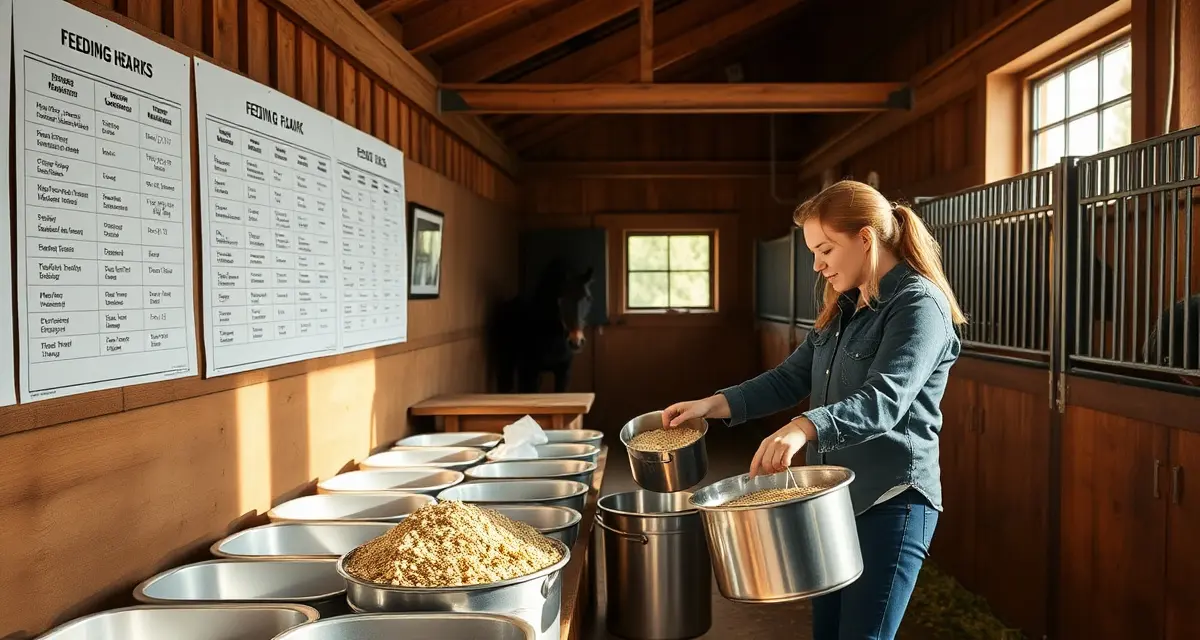
Feeding Schedules: How to Create an Effective Program for Your Barn
A feeding schedule at an equine facility is more than a list of what each horse eats. It is a health management tool. Consistent feeding times reduce stress-related digestive issues. Accurate portion management maintains body condition. Individual protocols ensure that horses with special nutritional needs receive the right care, not the barn default.
The Foundation: Consistency in Timing
Horses are creatures of strong habit with highly sensitive digestive systems. Irregular feeding times disrupt gut motility and increase colic risk. A barn that feeds at 7am and 5pm every day is providing better care than one that feeds when the staff arrives and gets around to it, regardless of everything else being equal.
When designing your feeding schedule, pick times you can reliably hold and staff accordingly. The horses will adapt to almost any consistent timing. What they do poorly with is unpredictability.
If your morning schedule requires barn staff to be there by 6:30am to complete feeding by 7am, that is your staffing requirement. Schedule it properly rather than hoping someone will arrive in time.
Feeding Frequency
The horse's digestive system evolved for continuous small-intake grazing. Domesticated horses often receive two discrete meals per day, which is a significant departure from their natural pattern. The longer the gap between feedings, the higher the risk of gastric ulcers from prolonged acid exposure to an empty stomach.
Practical approaches to address this:
Free-choice hay: For horses that can maintain appropriate body condition without grain, free-choice grass hay access is the closest practical approach to continuous forage availability. Not all horses are candidates (easy keepers, horses with metabolic conditions, horses on restricted diets).
Slow feeders and hay nets: These extend the time a horse spends consuming a given amount of hay, stretching the interval between meals without increasing total intake.
Three feedings per day: Some high-performance facilities feed three times daily, adding a midday grain meal for horses in heavy work. This requires adequate staffing but significantly improves the feeding pattern for performance horses.
Late-evening hay: A final hay feeding before the barn closes for the night extends forage availability through the night hours when horses are most likely to have extended stomach-empty periods.
Designing Individual Rations
Each horse's ration should be designed based on its individual needs: body condition score, workload, age, health conditions, and the owner's goals. A barn-wide "one size feeds all" approach may be practical to manage but compromises the care of horses at either end of the nutritional needs spectrum.
For each horse, the ration design should consider:
Hay quality and type: Nutrient content varies significantly between grass and legume hays and between cuttings. A horse on grass hay as its sole forage has different supplementation needs than a horse eating high-protein alfalfa.
Grain quantity relative to workload: A horse in light work needs minimal grain or none. A horse in heavy training needs energy density that hay alone cannot provide. Match the grain program to the actual workload, not to what is convenient to feed.
Body condition trend: A horse that is consistently losing weight needs a caloric intervention. A horse gaining weight despite a standard ration needs a reduction or a lower-calorie alternative. Monitor body condition and adjust rather than feeding the same ration indefinitely.
Special Protocols
Horses with metabolic conditions (insulin resistance, PPID/Cushing's, PSSM) have dietary restrictions that must be followed precisely. A horse that should not receive high-NSC hay or any grain getting the standard barn ration can have serious health consequences. These protocols need to be flagged clearly on the feeding chart so no staff member makes a substitution.
BarnBeacon stores individual feeding protocols per horse and makes them accessible on mobile devices during feeding, so staff have the right information at the stall door. For the broader care schedule that feeding protocols sit within, see feeding and care schedules. For managing inventory to support these programs, see feed management.
Feeding done right is one of the most impactful things a facility can do for the long-term health of every horse in its care.